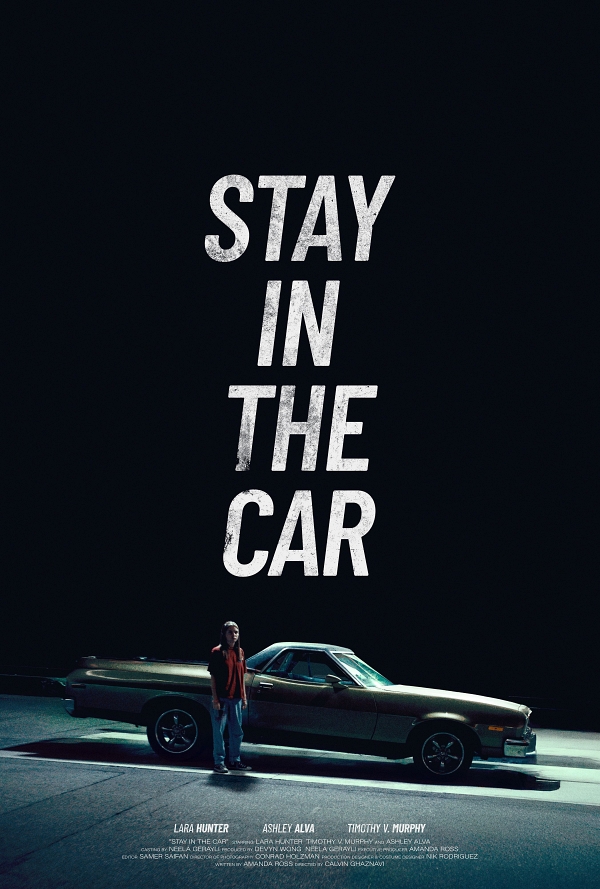
Writer Amanda Ross is stepping into filmmaking with a deep personal debut. Her emotionally charged short film Stay In The Car, directed by Calvin Ghaznavi, is set to world premiere at CREDO23 later this month, bringing a quietly powerful story of survival, resilience, and self-realization to the screen.
Starring Lara Hunter (Dead Life), Timothy V. Murphy (Law & Order: Organized Crime), and Ashley Alva (Bird Box), the short film unfolds over the course of a single evening. At its center is a fifteen-year-old girl waiting inside her mother’s El Camino as the night stretches on around her.
Set beneath the dim glow of streetlights and the distant hum of sirens, the film captures a moment suspended in time. While little seems to happen on the surface, the emotional stakes quietly build as the young girl confronts a realization that will shape the course of her life.
Based on real events from Ross’s childhood, Stay In The Car explores the fragile line between safety and survival, love and neglect. Through stillness and silence, the film reveals the moment when a young girl must decide whether to remain inside the chaos of her environment or step toward an uncertain freedom of her own making.
For Amanda Ross, bringing this story to the screen represents both a creative milestone and a deeply personal act of storytelling.
‘Stay In The Car’ is based on lived experience. What was the emotional turning point when you knew this story needed to become a film? Stay In The Car comes from a much larger story I’ve carried with me all my life. From an early age I’ve felt a strong desire to share my experiences in a way that might serve others. The moment it became a film was when I realized a single snippet from that story could stand on its own. When I imagined my daughter, an actress, portraying a younger version of me and getting to collaborate with her on a project like this, that’s when the idea of bringing it to film finally clicked.
‘Writing from personal history can be both liberating and confronting. What was the most challenging moment during the writing process? Writing the script was therapeutic, but it also meant revisiting some of the most painful moments from my past. The biggest challenge was conveying the inner life of a young girl growing up in an abusive environment without explaining her entire backstory. Some people ask, “Why doesn’t she just leave?” But for many children and victims of domestic violence, leaving isn’t that simple.
How did you balance authenticity with cinematic storytelling? Because this story was my personal lived experience, authenticity was incredibly important. I tried to stay as close as possible to what actually happened that night, but even more important was staying true to the emotional chaos of that moment.
The film explores the tension between love and neglect. How did you portray that complexity? I wanted to show the absence of the love and care that should have been there, and how a child processes that realization when they understand they are essentially on their own in chaos they didn’t choose.
How did working with director Calvin Ghaznavi shape the script? Calvin was wonderful to collaborate with. He asked thoughtful questions throughout the process that helped uncover what was really happening underneath the scene. Because we had such a short window to tell the story, we needed the emotional depth to surface quickly, and his direction helped make that possible.
The film relies heavily on silence and stillness. How do you write tension when very little is said? I was counting on the actors to bring that forward, and they did beautifully.
Was there a scene you rewrote repeatedly? Yes. There was one scene Calvin and I worked through many times. Eventually we removed it entirely. Sometimes when something refuses to come together, it’s a sign the story is asking for simplicity. In the end, the film became stronger without it.
Casting plays a key role in such an intimate story. How did the casting process unfold, and what made Lara Hunter, Timothy V. Murphy, and Ashley Alva the right choices for these roles? Lara and Tim were both connected to the project from the beginning. The script was written with Lara in mind for the role of Salem, and Tim, who is a friend and neighbor, and who introduced us to Calvin, joined early on as well. When it came time to cast Dee, the producers were very collaborative and included me in the process. Ashley stood out right away because she captured the presence and emotional complexity we were looking for in that character.
What does “choosing yourself” mean to you today? It means believing your life can be more than the circumstances you were born into. Salem stepping out of the car represents that moment of realization. No one was coming to save her. She had to be the one to stand up for herself.
Did you feel a responsibility toward people with similar experiences? More than responsibility, I felt hope. I hope the film helps people feel less alone and reminds them that things can get better.
Was it difficult revisiting such personal memories on set? There were moments that surprised me emotionally. Ashley, who plays my mother, captured her so accurately that it felt eerie. And seeing Lara in pain, even though she was acting, brought tears to my eyes.
Was there hesitation in sharing something so personal? Absolutely. I’m a fairly private person, and I experienced a lot of imposter syndrome during the process. There were moments when I questioned whether my story was important enough to tell.
How did working with your daughter affect the creative process? I was incredibly impressed with Lara. I made a conscious effort not to micromanage her performance. She asked thoughtful questions and was very open to direction when we needed to find specific emotional beats.
Lara’s performance as Salem brought an additional emotional layer to the film. Not only does she portray the young protagonist navigating a painful moment of realization, but she does so while embodying a version of me as her own mother’s past. The result is a performance shaped by both emotional sensitivity and personal understanding.
As mentioned, we cast veteran character actor Timothy V. Murphy, known for his commanding screen presence in series such as Sons of Anarchy, Snowpiercer, and Law & Order: Organized Crime. Opposite Lara, we cast actress Ashley Alva who delivers a striking performance as my mother whose choices and struggles create the environment Salem must ultimately confront. Alva’s portrayal was at times almost uncanny in its authenticity, capturing details that felt startlingly familiar.
What kind of stories do you feel drawn to writing next? This story came from a very personal place, and it’s only a small part of a much larger story I might continue exploring. At the same time, I’m very drawn to psychological thrillers, which often explore survival and resilience in different ways.
With its intimate storytelling and emotional honesty, Stay In The Car marks a striking debut for Ross as a screenwriter, and a film that speaks quietly but powerfully about survival, courage, and the moment someone chooses a different path.
CREDO23 runs from March 27th – 29th at the iconic American Legion Hall, Post 43, on Highland Avenue in Los Angeles. ‘Stay In The Car’ will screen on March 28th at 12pm. Tickets are available
here.
Website