Los Angeles–based actor Justin He continues to explore psychologically complex characters in independent filmmaking. A recent graduate of the Master of Fine Arts Acting for Film program at the New York Film Academy, He brings a unique perspective to his work, shaped by earlier training at the American Academy of Dramatic Arts and an academic background in computer engineering at the University of California, Irvine. Known for approaching performance with both analytical precision and emotional depth, He recently stepped into the horror genre for the short film Night Shift, directed by Caden Kim. In this interview feature, Justin He reflects on returning to his alma mater for the project, the challenge of portraying a terrifying creature born from a character’s psyche, and the intense creative process behind bringing the film’s haunting atmosphere to life.
What is Night Shift about? Night Shift is a psychological horror story centered on a worker named Locke who finds himself trapped in a surreal and unsettling night. While working alone at a checkout window, Locke is visited by Ash, a cheerful delivery driver who encourages him to step away from work and take a late-night drive.
But when the power suddenly goes out, the quiet building becomes a maze of flickering lights, strange noises, and the growing sense that something is stalking him. As the night begins repeating itself in disturbing loops, Locke becomes increasingly terrified until he confronts the mysterious creature pursuing him.
Ultimately, he realizes the monster is a manifestation of his own exhaustion, isolation, and fear. When the night resets once again, Locke chooses a different path, accepting Ash’s invitation to leave the building and break free from the suffocating routine that has been trapping him.
What made this project particularly meaningful for you? This project was especially meaningful because it brought me back to the University of California, Irvine, where I previously studied computer engineering. Working with filmmakers who also came from my alma mater gave me a bittersweet sense of nostalgia and comfort.
It was also inspiring to see how many different backgrounds the cast and crew came from. Some studied fields closely related to filmmaking, like theater or film production, while others came from completely different disciplines, such as public health or psychology. Seeing people from such diverse academic paths come together to create a film reminded me of how collaborative and inclusive filmmaking can be.
What was your experience like working on the production? The film was shot over two days, with about six hours of filming each day. By the end of each day, we were completely exhausted, but it was the kind of exhaustion that comes from doing something creative and fulfilling.
In my case, the process didn’t end when filming wrapped. Because of the makeup and creature design involved in my role, I had to spend additional time removing the makeup after each shoot day. Even though the schedule was demanding, the entire experience felt rewarding because everyone on set was passionate about the project.
You portray the creature haunting Locke. How did you approach building that character? The creature is essentially a mirror image of Locke’s inner turmoil. Because of that, it was important for me to understand the protagonist’s psyche and emotional state before deciding how the monster should move or sound.
From the moment I was cast, I had only two days to prepare before filming began, and there was no rehearsal period. That meant I had to analyze the script as deeply as possible on my own. During the makeup process each day, which took about an hour, I used that time to mentally transition into the character.
The discoveries truly happened during the filming process itself. With multiple takes available, I was able to explore different physical movements, vocal choices, and artistic approaches in response to feedback from the director.
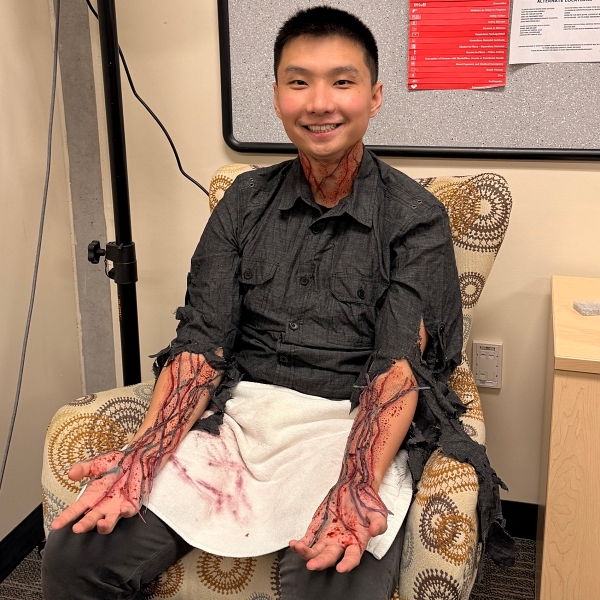 What were some of the technical challenges of performing the creature?
 The costume and makeup process was one of the most challenging aspects. Due to the short preparation period, I wasn’t able to have an in-person fitting prior to filming. The costume department impressively created the creature mask using only my provided head measurements.
When I first saw it, the mask looked surreal and terrifying, which was precisely what the role demanded. It didn’t fit perfectly at first because parts were a bit tight, but the costume designers adjusted it on the spot and padded it, so it fit comfortably.
The makeup process itself took about an hour each day, and removing it took just as long. Some of the body paint lingered for a few days after filming, though thankfully, I wasn’t allergic to any of the materials used.
The role also demanded a lot vocally. What did that involve? The creature screams, growls, and shrieks, so vocal performance was a huge part of the role. I had to think carefully about what a monster should sound like, how aggressive the sound should be, and how to maintain that intensity across multiple takes.
At the same time, I had to protect my voice so I could continue performing throughout the shoot. That’s where my vocal training really helped. It allowed me to push my performance while still maintaining control of my voice.
What was the atmosphere like on set? Everyone on set had other responsibilities in their lives, so there was definitely some stress in the air. But despite that, the environment remained extremely friendly and supportive.
People communicated clearly, and the team constantly checked in with one another to make sure everyone was doing okay and that nothing was becoming overwhelming. That level of collaboration really made the experience enjoyable, even during the most demanding moments.
Were there any memorable behind-the-scenes moments? One moment that everyone still laughs about happened late into the night. Because I had to be in makeup early, I spent a lot of time waiting in the holding room that doubled as the editing lab.
At one point, I decided to take a nap so I could preserve my energy for the scenes. I suddenly woke up to someone shouting “Cut!” and realized the crew had quietly moved the camera setup into the same room while I was sleeping.
Apparently, they only realized I was there when they heard a small snore during the take. Everyone started laughing, and thankfully, I hadn’t disrupted the shot. It ended up being one of those funny moments that helped break the tension on set.
What was your personal highlight from the shoot? My biggest highlight was performing in front of the camera for the first time in full creature makeup. The mask and makeup design helped me fully transform into the character, and it really enhanced the physical and vocal performance.
After the first take, several cast and crew members said they could hear my voice from other rooms on set and that it genuinely frightened them. Their reaction was incredibly validating and confirmed that the performance was working as intended.
Where has the film been shown so far? At the moment, there are no festival plans announced for Night Shift. The film was screened as part of the FMS Spotlight Showcase on February 26, where audiences had the opportunity to see the project alongside other emerging filmmaker works.
How would you describe the kinds of projects you prefer to work on? It’s always exciting to take on new projects, especially when there’s a strong sense of collaboration. When the entire cast and crew are working as one team, it creates an environment where people can truly explore filmmaking as an art form.
For me, that collaborative spirit matters more than the genre, style, or theme of the project. When everyone is committed to creating something meaningful together, that’s when the magic of filmmaking really happens.
With projects like Night Shift, Justin He continues to explore roles that challenge him both physically and psychologically. From engineering classrooms to film sets, his journey reflects a growing dedication to the craft of storytelling, one that blends discipline, creativity, and a willingness to embrace transformation. As he continues building his career in film and television, audiences can expect to see him taking on roles that push the boundaries of performance and imagination. IMDb