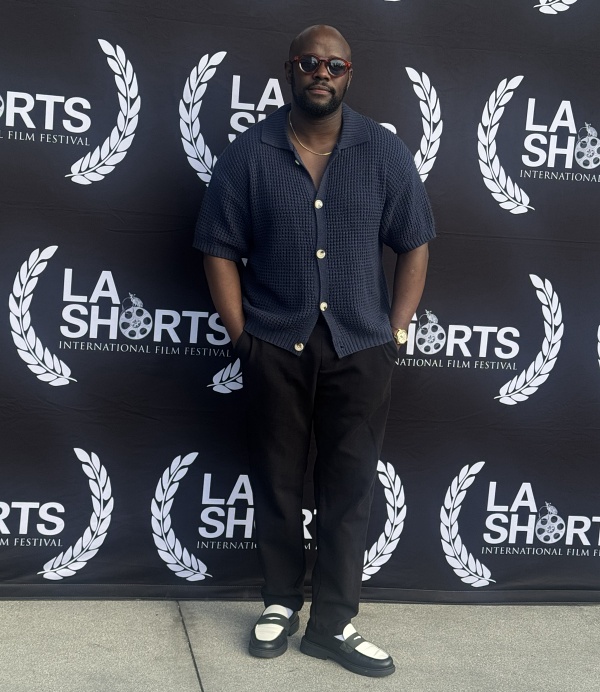
Actor Dennis Mailu continues to expand his Hollywood résumé with ‘Catalina’, an ambitious science-fiction drama exploring artificial intelligence, caregiving, and the future of human connection.
Written and directed by Martin Russell Johnson, ‘Catalina’ is set in a near future where artificial intelligence has replaced traditional caregivers. The story follows a desperate robot mechanic attempting to save his dying mother by transferring her consciousness into an illegal robot named Catalina.
For Mailu, who portrays a Black Market Operative within the film’s futuristic underground world, the project offered the opportunity to combine physical performance with a story carrying a much larger social message.
“I enjoyed playing a fierce, Afrocentric version of myself and working within this near-future world,” Mailu says. “Being a villain who genuinely believes in what he is doing is always interesting because it gives you something deeper to play than simply being threatening.”
Mailu’s character serves as the lead henchman to Fatima, a Sudanese immigrant operating an illegal AI arms shop. His responsibility is to ensure that clients follow the rules and that the clandestine operation remains protected. The role required Mailu to develop a specific physical language for the character, particularly because he is presented as someone with military training.
“I handled a weapon in the film, so I needed to work on the way the character moved and carried himself,” he explains. “My stage combat background helped me learn quickly, but you still have to make every physical choice feel natural for the person you are portraying.”
Physical precision has become an increasingly important element of Mailu’s screen work. His background in mixed martial arts and stage combat has allowed him to move comfortably between dramatic and action-oriented roles, while maintaining an acting philosophy centered on behavior and authenticity.
A Story About Care in the Age of AIAlthough ‘Catalina’ is set against an Afrofuturist science-fiction backdrop, its central concern is deeply human. The film examines what could be lost when caregiving becomes automated, questioning whether technology can ever replicate the emotional presence, dignity, and empathy involved in caring for another person. That theme resonated personally with Mailu.
“I have experience with caregivers in my own life, so there was something very real in the story for me,” he says. “It illuminates caregiving as a sacred human tradition. Technology may continue to evolve, but there are parts of human connection that cannot simply be replaced.”
That focus helped distinguish ‘Catalina’ long before cameras began rolling. The project was selected as the inaugural recipient of the ‘‘$50,000 Storytelling with Care short-film grant,’’ created by Caring Across Generations and the National Domestic Workers Alliance. The initiative was developed in partnership with Participant and supported by the HRTS Foundation, with the goal of encouraging more nuanced and authentic portrayals of caregiving, disability, aging, and care work on screen.
More than 200 projects were submitted for the inaugural grant cycle before ‘Catalina’ was selected. The support extended beyond production financing. The Storytelling with Care initiative was designed to connect emerging filmmakers with entertainment-industry mentorship, professional development, festival support, and wider opportunities within Hollywood.
The team behind the initiative included impact professionals associated with Alfonso Cuarón’s Academy Award-winning film ‘Roma’, a project widely recognized for bringing the experiences and dignity of domestic workers into a global cinematic conversation.
Spotlighted Within the Hollywood IndustryFollowing its selection, ‘Catalina’ was introduced to the entertainment community through the Hollywood Radio & Television Society at an industry event focused on storytelling, resilience, and representation. The event was hosted by ‘‘Warner Bros. Television Group,’’ placing the project before an audience of industry professionals and entertainment executives.
The HRTS Foundation, which supports access, education, and professional opportunities for emerging entertainment professionals from underrepresented backgrounds, also helped amplify the film and Johnson’s work as part of the initiative.
That level of institutional support gave ‘Catalina’ a professional platform extending well beyond the traditional independent short-film production model. The project also received an additional industry showcase in November 2025 when a special cast and crew screening was held at the ‘‘NAACP+ Screening Room at SAG-AFTRA’’ in Los Angeles.
For Mailu, experiences of that kind represent an important extension of the work itself.
“Every project gives you the opportunity to grow creatively, but there is also something meaningful about being part of a film that creates conversation outside the screen,” he says.
From Burbank to an Academy-Qualifying FestivalProduction took place in Burbank, California, where Mailu filmed his scenes inside the movie’s Black Market Shop. Now completed, ‘Catalina’ is moving into its festival phase. The film made its world premiere on August 7, 2026, at the LA Shorts International Film Festival, screening at Regal North Hollywood.
Celebrating its 31st year, LA Shorts International Film Festival is an Academy Award-qualifying festival and has long served as an important showcase for short-form filmmaking in Los Angeles. The selection gives ‘Catalina’ another significant platform as it begins its public festival journey.
The film has also been nominated for ‘‘Best Science Fiction at Venice Shorts.’’ Should it advance to the next round, the project is expected to screen at the Fine Arts Theatre in Beverly Hills in October 2026. For a film rooted in questions about AI, labor, culture, and caregiving, the growing festival attention reflects the timeliness of its central themes.
An International PerspectiveMailu brings his own international experience to that conversation. Born and raised in Nairobi, Kenya, his first language is Kikamba, the language of his Kamba heritage. He also speaks Swahili and English fluently.
His acting journey began through stage productions during high school, where performing eventually evolved from an interest into a career ambition. After writing and appearing in an award-winning play, Mailu made the decision to pursue acting internationally. That decision took him first to the United Kingdom, where he lived for nine years while continuing to perform, and eventually to Los Angeles.
He later trained at both the New York Film Academy and the American Academy of Dramatic Arts, where he received the prestigious Charles Jehlinger Award for Excellence in Acting.
“My roots and heritage from Kenya, together with the experience of living in different parts of the world, give me a multifaceted perspective as an actor,” Mailu says. “They influence the choices I make and allow me to bring something personal to every character.”
That background also informs his interest in projects that broaden representation. For Mailu, the African diaspora should not exist at the margins of mainstream entertainment, but as part of the larger cultural landscape.
“I want my work to contribute to greater inclusivity by being part of stories that showcase African and diasporic perspectives in a meaningful way,” he says. “The more collaboration there is between Hollywood and artists from different cultures, the stronger the storytelling becomes.”
Building a Diverse Screen Career‘Catalina’ joins an increasingly varied list of credits for Mailu. His work includes the television pilot ‘Blue Light Melody’, the studio feature ‘Big George Foreman’, the Shudder-acquired horror feature ‘Parasomnia’, ‘PREY’, ‘The Spell That Backfired’, and the award-winning thriller ‘Person of Interest’. His performance in ‘Person of Interest’ earned multiple Best Supporting Actor honors during the film’s international festival run.
In ‘Parasomnia’, Mailu took on an entirely different challenge, using extensive prosthetics and special-effects makeup to portray a nightmarish manifestation of a young woman’s deceased father. The horror film later screened at FrightFest, Brooklyn Horror Film Festival, and the Overlook Film Festival before being acquired by Shudder.
Across those projects, Mailu has continued to demonstrate a willingness to move between genres, from horror and action to science fiction and socially conscious drama.
With ‘Catalina’, that versatility now intersects with a project carrying substantial support from organizations across the entertainment and social-impact sectors. The film’s path has included a competitive $50,000 grant, backing from Caring Across Generations and the National Domestic Workers Alliance, involvement from Participant and the HRTS Foundation, an industry showcase hosted by Warner Bros. Television Group, a screening environment at SAG-AFTRA, and an upcoming world premiere at an Academy-qualifying film festival.
For Mailu, those milestones add another layer to a career built across continents and creative disciplines.
“I’ve always believed that daring to be great requires courage and sacrifice,” he says. “Every project, every culture, and every experience adds something to you as an artist. My goal is to keep growing and to keep contributing to stories that have something meaningful to say.”
With ‘Catalina’ now entering the festival circuit, Dennis Mailu is doing exactly that.